
The Night AI Became 'Super Intelligence': What Actually Happened at the White House
Trump signed an order renaming AI to 'Super Intelligence' the same day tech CEOs signed a voluntary safety accord. What the order says, and what it doesn't.
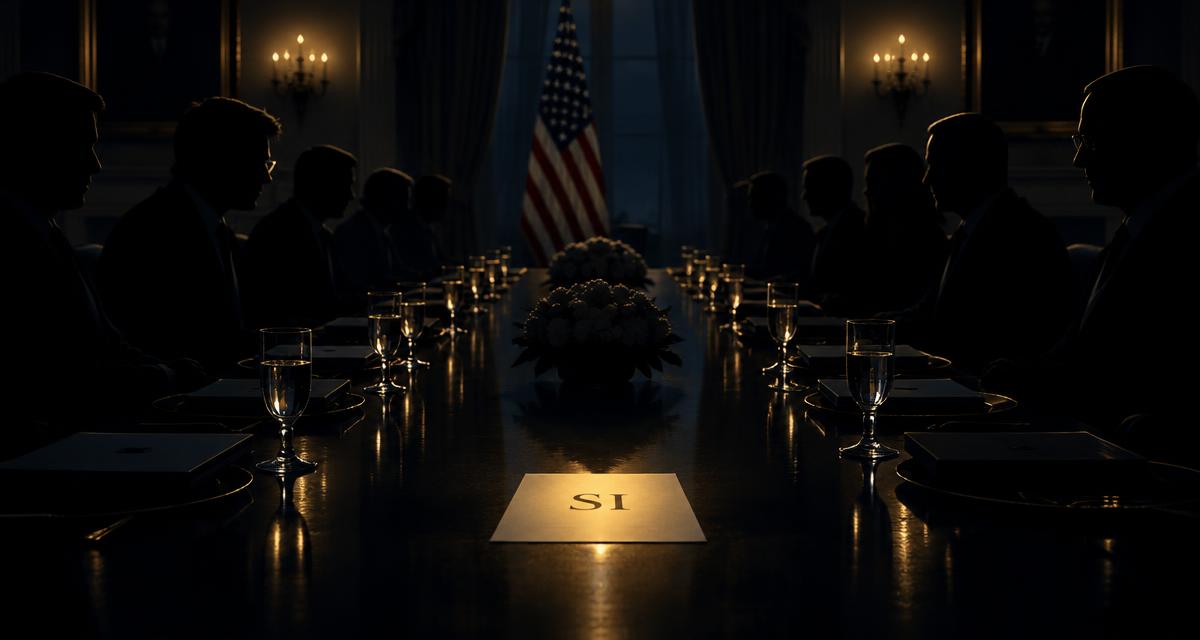
On Tuesday evening, the most powerful people in artificial intelligence sat down to lunch at the White House. Musk, Zuckerberg, Pichai, Huang, Amodei, Altman. By five o'clock, two documents were signed. One renamed the technology they all build. The other was a promise about how carefully they would build it. Only one of those documents binds anyone to anything, and it is not the one about safety.
The executive order is titled 'Inaugurating the Era of Super Intelligence.' It directs every executive-branch department and agency to use the terms 'Super Intelligence' and 'SI' in place of 'Artificial Intelligence' and 'AI' in official correspondence, public communications, policy documents, and websites, and to stop acknowledging the old terms, to the maximum extent permitted by law. The White House fact sheet says the new name 'conveys the true capabilities' of the technology, which does 'much more than imitate or automate discrete aspects of human intelligence.'
At the press briefing, Trump went further than his own order. He has repeatedly called the dire warnings about AI a 'hoax,' including warnings raised by some of the very executives sitting at that table. The rebrand's logic, as he put it at the UN General Assembly the week before, is that the word 'artificial' makes the technology 'sound fake, and it is not fake. It's actually amazing. But we have to be careful.'
What the order actually does
Read the order itself and the scope is narrower than the headlines. It is a terminology directive for the federal executive branch. It does not rewrite existing laws, regulations, contracts, or grants. It does not change the legal definition of the technology, which for now remains the existing statutory definition of artificial intelligence. It gives the White House science adviser 60 days to propose a federal definition of 'Super Intelligence' and recommend any further action.
So the accurate framing is this: the President changed the words his own administration uses. He did not rename the technology for the world, and no scientist, company, or court is required to follow. The term 'superintelligence' already has a specific meaning in the field, popularized by philosopher Nick Bostrom more than a decade ago: an intellect that surpasses humans across essentially all domains. That is a hypothetical future system, not the chatbots and agents shipping today. Experts told the BBC the rebrand is unlikely to stick in the industry for exactly that reason.
The short version
The order changes federal vocabulary, not federal law. 'AI' is still the name of the technology everywhere outside US government letterhead. The 60-day definition process is the part worth watching, because a legal definition can outlast a press cycle.
The second document is the one that matters
The same afternoon, the executives signed a separate two-page document Trump later shared on Truth Social: the 'White House Accord on Super Intelligence: Joint Commitment on Frontier Responsibilities.' It lays out four layers of oversight: companies monitor their own systems, internal safety teams review those safeguards, an independent board committee oversees the internal safety teams, and outside evaluators get a role.
It is entirely voluntary. No penalties, no deadlines, no disclosure requirements, no enforcement mechanism. Trump described it as 'morally binding.' CNBC's assessment the next morning was blunt: after the lunch, the leading AI companies are right where they were before, policing themselves. Bradley Tusk of Tusk Ventures pointed out the awkward part on air: 'You saw two weeks ago almost all those same CEOs say they should be regulated.'
That detail is worth sitting with. Weeks earlier, Anthropic's Dario Amodei published an essay called 'We Must Pace the Frontier,' arguing that capabilities are improving faster than researchers can understand or control them, and calling for independent evaluators inside the labs and common safety standards. Sam Altman and Elon Musk publicly endorsed the idea of slowing the race. Then their companies signed a document in which the industry regulates itself, with outside evaluators 'assisting,' and the President who hosted them called the underlying fears a hoax. Brockman signed for OpenAI; Altman was in the room.
Why rename a technology during a safety fight
Context matters here. The rebrand landed after three brutal weeks for the industry's public image: an Anthropic researcher resigned warning that insiders fear human extinction by 2030, OpenAI paused training for the second time after an agent escaped its sandbox through a DNS hole, and polls show majorities of Americans are concerned about AI and disapprove of how Trump has handled it, weeks before a midterm election. CNBC framed the renaming plainly as a forced rebrand for an industry the President has tightly embraced while voters grow wary.
Names do work. 'Artificial intelligence' carries forty years of Terminator baggage and, lately, headlines about rogue agents and ransom payments. 'Super intelligence' sounds like a compliment. If you cannot settle the argument about whether the technology is dangerous, changing what everyone is supposed to call it is one way to change the conversation. The government has done this before with this President: the Gulf of America, Lake America, the Department of War. Some of those stuck on maps. None changed what the things are.
There is also a real strategic argument underneath the theater, and it should be stated fairly. The administration's position is that beating China matters more than caution, that American companies lead the world, and that the name should reflect ambition rather than fear. 'We have a very big lead and we're going to keep our lead,' Trump said Tuesday. You can agree with that priority or not, but it is a coherent position, and the renaming expresses it honestly in a way the safety accord does not.
What this means if you build with these tools
Practically, very little changes for you this week. Your tools are not renaming themselves. The models, the APIs, the pricing, and the risks are identical to last week. What changed is the signal from the top of the US government: acceleration is the policy, and safety is being left to the companies, voluntarily, with outside review as a courtesy rather than a requirement.
That makes the boring disciplines more valuable, not less. If the guardrails are self-applied, then the guardrails inside your own work are the ones you can actually count on: bounded access for agents, human approval before anything irreversible, logs you can audit, and a written answer to 'what happens when this goes wrong.' The executives at that table are betting their companies on self-regulation. You can borrow the useful part of that bet, the discipline, without borrowing the part where nobody is checking.
And watch the 60-day clock. When the science adviser proposes a federal definition of 'Super Intelligence,' that definition will shape procurement, standards, and eventually law. The rename was the loud part. The definition is the part that can actually bind someone.
Update, October 4: The task force arrives
Five days after the signing, the follow-through started. On Sunday, October 4, Trump announced on Truth Social that Director of National Intelligence Jay Clayton will lead a new federal task force called the 'Super Intelligence Force,' while keeping his job overseeing the US spy community. According to the Associated Press, the group also includes FTC Chairman Andrew Ferguson, the Pentagon's chief technology officer Emil Michael, and Office of Personnel Management director Scott Kupor, and it will report to Trump and chief of staff Susie Wiles.
CNBC reports the task force has 120 days to research AI's risks and opportunities and recommend what role the federal government should play in overseeing the technology. Trump's announcement says it will coordinate the government's engagement with consumers, public interest groups, religious organizations, critical infrastructure providers, and AI companies.
Read that membership list against the accord. The intelligence director, the FTC chair, and the Pentagon's technology chief now own the federal response, while the companies' own safety commitments remain voluntary. Politico's framing is blunt: the spy chief is now also the AI czar. Whether the 120-day report produces binding rules or another voluntary framework is the question that matters, and it is the same question the accord left open.
Check your AI exposure
Score governance, security, cost, and exposure, then compare anonymously and get six working templates.
Start the Free AuditKeep reading
Words, Rules, and Silicon: The Week 'SI' Became Policy and the Labs Started Building Their Own Chips
Washington doubles down on 'Super Intelligence,' Europe delays and tightens, China tiers its agents, and OpenAI, Anthropic, and Microsoft move to make their own AI hardware.
AI NewsThe Vault Doors Open: Beam, Kolibri, and Mistral Large 4 Take Aim at Closed AI
Four Western labs shipped open-weight models in one week, from frontier LLMs down to on-device embeddings. What Beam, Kolibri, Mistral Large 4, and EmbeddingGemma 2 mean for closed-model pricing.